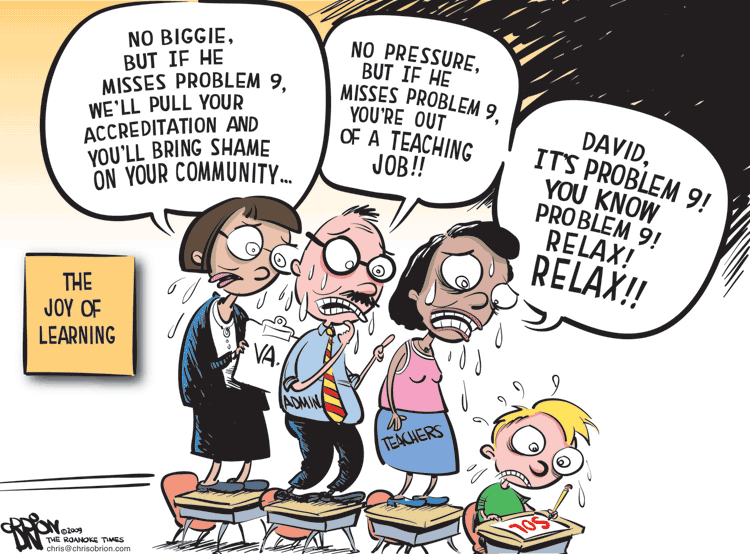
If teachers were to grade their students in an inconsistent, convoluted and subjective manner, they would be run out of the teaching profession.
In their crusade to point fingers and direct blame for the failings of our education system, however, our state's leaders created a similar system for evaluating our teachers.
Florida's policymakers turned a deaf ear to the teachers who tried to point out the inadequacies of the Collaborative Assessment System for Teachers (CAST) when it was being fast tracked through the lawmaking process for the sake of winning a pot of gold from the federal Race to the Top (RTT) grant program.
Nevermind that Florida is the same state that continues to refuse expanding Medicaid on the ground that they do not want abdicate states' rights to empower Washington to impose its will on 50 separate sovereign entities.
The rush to create a data-based evaluation system replaced the thoughtful and reflective process of passing laws with a frenzy to chase after federal funding and with a political power grab that still leaves local school districts dizzy with confusion and disarray.
I was encouraged to read in the Orlando Sentinel a thoughtful column by Beth Kassab that exposes the deficiencies in the CAST system and how it actually hurts the teachers whom we trust to educate our children.
For example, she shares the story of how one Central Florida high school is one of the highest performing schools in the state. This 'A' school enjoys a graduation rate that is the envy of others and yet their learning growth was negative.
"How can this be?" asks Kassab, "How can a school with excellent student performance be populated with clueless teachers?" I know how these same education professionals can improve a school grade and yet be subject to the sanctions and condemnation that are designed to punish more than enlighten.
There are serious inconsistencies in how we rate our schools and our teachers. While FCAT is the instrument for measuring student growth in language arts, mathematics and selected science courses, it was left to the individual school districts to create assessments for the non-FCAT courses. This resulted in a patchwork of 67 school systems with varying benchmarks for student success. The state decided that all courses would have some form of assessment for all non-FCAT courses, but failed to support this mandate with funding. Instead of a reliable system of tracking student progress, we are doomed to compare apples with oranges across county lines.
What is the most absurd aspect of the testing and data driving our perception of public schools is that FCAT scores are often used to tell us what non-FCAT teachers are doing for their students. For example, a guidance counselor or an art teacher can be judged based on schoolwide FCAT numbers. Furthermore, reading scores are being used to indicate the quality of a history teacher's work. The measurements are all over the place and can potentially harm those educators who are indeed trying their best.
Besides the assessment part of teacher evaluations, our leaders presumed that the observation-based section of teacher assessments would be equally objective as the CAST instrument invited administrators to monitor their teachers in the classroom based on one day's worth of sitting in a classroom and using this single class period as the basis for judging a year's worth of teaching.
This, in my opinion, is rife with politics because administrators are given free reign to make up their minds based on an hour's worth of what they see. This simply encourages teachers to design lessons that are geared to impress their superiors and these dog-and-pony shows fail to actually reflect the individual talents for which we have trusted our educators with using in their respective classrooms. Once the observation is complete, the evaluator's word is gospel and all else be damned.
In an age of high stakes testing, this is a most perverse form of high stakes evaluations. Failure to make the grade based on these flawed metrics can ultimately result in teachers' pay being frozen or even in their termination. Yes, the beatings will continue until morale improves.
"We can be an 'A' school and conceivably get that [paycheck] bonus, but if we get three negative scores in a row then the teachers can all be replaced," said one prinicpal in a letter to state lawmakers, according to Kassab's commentary.
Yes, this is a messed up system that is supposed to help our students, but in the meantime is destroying Florida's teaching profession.
For more information about Kassab's commentary, please see this link.

