Showing posts with label public schools. Show all posts

Saturday, April 6, 2013

Failure by design


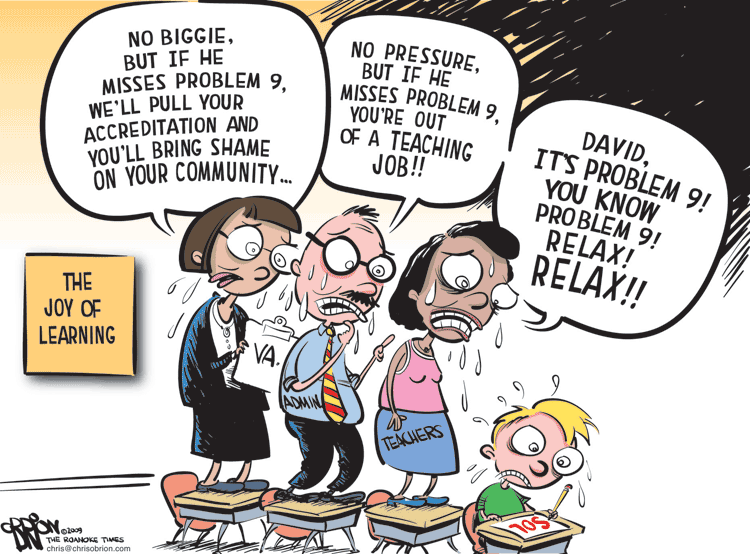
If teachers were to grade their students in an inconsistent, convoluted and subjective manner, they would be run out of the teaching profession.

In their crusade to point fingers and direct blame for the failings of our education system, however, our state's leaders created a similar system for evaluating our teachers.

Florida's policymakers turned a deaf ear to the teachers who tried to point out the inadequacies of the Collaborative Assessment System for Teachers (CAST) when it was being fast tracked through the lawmaking process for the sake of winning a pot of gold from the federal Race to the Top (RTT) grant program.

Nevermind that Florida is the same state that continues to refuse expanding Medicaid on the ground that they do not want abdicate states' rights to empower Washington to impose its will on 50 separate sovereign entities.

The rush to create a data-based evaluation system replaced the thoughtful and reflective process of passing laws with a frenzy to chase after federal funding and with a political power grab that still leaves local school districts dizzy with confusion and disarray.

I was encouraged to read in the Orlando Sentinel a thoughtful column by Beth Kassab that exposes the deficiencies in the CAST system and how it actually hurts the teachers whom we trust to educate our children.

For example, she shares the story of how one Central Florida high school is one of the highest performing schools in the state. This 'A' school enjoys a graduation rate that is the envy of others and yet their learning growth was negative.

"How can this be?" asks Kassab, "How can a school with excellent student performance be populated with clueless teachers?" I know how these same education professionals can improve a school grade and yet be subject to the sanctions and condemnation that are designed to punish more than enlighten.

There are serious inconsistencies in how we rate our schools and our teachers. While FCAT is the instrument for measuring student growth in language arts, mathematics and selected science courses, it was left to the individual school districts to create assessments for the non-FCAT courses. This resulted in a patchwork of 67 school systems with varying benchmarks for student success. The state decided that all courses would have some form of assessment for all non-FCAT courses, but failed to support this mandate with funding. Instead of a reliable system of tracking student progress, we are doomed to compare apples with oranges across county lines.

What is the most absurd aspect of the testing and data driving our perception of public schools is that FCAT scores are often used to tell us what non-FCAT teachers are doing for their students. For example, a guidance counselor or an art teacher can be judged based on schoolwide FCAT numbers. Furthermore, reading scores are being used to indicate the quality of a history teacher's work. The measurements are all over the place and can potentially harm those educators who are indeed trying their best.

Besides the assessment part of teacher evaluations, our leaders presumed that the observation-based section of teacher assessments would be equally objective as the CAST instrument invited administrators to monitor their teachers in the classroom based on one day's worth of sitting in a classroom and using this single class period as the basis for judging a year's worth of teaching.

This, in my opinion, is rife with politics because administrators are given free reign to make up their minds based on an hour's worth of what they see. This simply encourages teachers to design lessons that are geared to impress their superiors and these dog-and-pony shows fail to actually reflect the individual talents for which we have trusted our educators with using in their respective classrooms. Once the observation is complete, the evaluator's word is gospel and all else be damned.

In an age of high stakes testing, this is a most perverse form of high stakes evaluations. Failure to make the grade based on these flawed metrics can ultimately result in teachers' pay being frozen or even in their termination. Yes, the beatings will continue until morale improves.

"We can be an 'A' school and conceivably get that [paycheck] bonus, but if we get three negative scores in a row then the teachers can all be replaced," said one prinicpal in a letter to state lawmakers, according to Kassab's commentary.

Yes, this is a messed up system that is supposed to help our students, but in the meantime is destroying Florida's teaching profession.

For more information about Kassab's commentary, please see this link.

Saturday, March 23, 2013

Thank you, Diane Ravitch!

My friends at the Clay County Education Association informed me this morning that my open letter to Governor Rick Scott was posted on Diane Ravitch's blog.

Dr. Ravitch is a respected and renowned education advocate and I believe that it is an honor to be included in her blog!

An open letter to Governor Scott

Monday, February 11, 2013

A matter of principals and principles


There is one question that I dread receiving as an educator.

“Why don’t you look into becoming an administrator?”

Thankfully, I am usually not sipping from the coffee that provides me with the sweet nectar of wakefulness for the day as I would surely be spitting it out in a random state of incredulity. Why do many good teachers refuse to cross over into the ‘dark side?’ There are quite a few Jedi knights in the classroom who would indeed make lovely principals and assistant principals, especially considering the increase in pay.

While the pay jumps a bit, the stresses and responsibilities make an even larger jump for already beleaguered educators.

When I am asked this question, I immediately think of the study in which college students were asked to play prisoners and wardens. In an experiment that made Lord of the Flies look like an Outward Bound romp in the wilderness, these students devolved into madness and depravity that destroyed the spirits of those who participated.

In this study, which needless to say, will never be conducted again, the randomly appointed wardens became drunk with power and took on a sadistic role that degraded the dignity of those who were once their peers in the classroom.

Egads, my friends! This Stanford experiment was all too real as the guards exacted psychological torture that were all too real to the same classmates who were their study partners a few weeks before. All it took was six days to teach us that this study was all too real a study in human depravity. Guards assaulted prisoners with fire extinguishers. Prisoners were forced to use buckets for toilets. Prisoners were forced to sleep naked on the cold, concrete floors of their simulated cells. When the experiment was called off, protests arose from the guards who liked their jobs a bit too much. Society learned that the roles that we play can sometimes take us over and make us forget our own humanity or the humanity of those around us.

But, I digress. The reason why I would never be caught dead lording over my colleagues is not because of a personal vendetta against any administrator in particular. The reason why I would never in a million years desert the classroom is because I wish to keep doing what I do best – nurture young minds and enrich learning to the best of my ability. I would never wish to get the amnesia that many folks get when they earn that much-envied promotion to what is considered the next logical step of their career. Most importantly, I do not want to be the good teacher who becomes a rotten principal.

I know that many people will ask me why a principal or any other administrator would take leave of their senses when they are working in the same schools with the same children as their subordinates. Allow me to provide some insights, with some help from One Mean MFA’s blog (http://onemeanmfa.wordpress.com/) and from colleagues who would like to speak up but either can’t or won’t for obvious reasons.

• The best educational leaders never forget that they were once followers. Once we get that office, it is tempting to cloister ourselves in an echo chamber that leads us to believe that we were specially ordained to command from on high. Unlike teachers, for whom it takes an act of Congress to be able to relieve themselves in a timely manner, administrators take for granted the simple dignities of having unlimited restroom privileges. While us humble teachers would be strung up for denying a restroom pass to a student, we face serious health problems that arise from putting our bladders on hold for the lion’s share of the school day. Furthermore, administrators have the luxury of closing the door to the world when they are overworked or overwhelmed. In this ivory tower, they can actually do their work in peace. The average teacher, however, must stay on his or her toes throughout the school day – balancing the duties of taking attendance, passing out graded work, delivering lessons, collecting work, disciplining students, cleaning up the room for the next class, setting up electronic equipment, writing hall passes, loaning supplies, grading papers, helping students, redirecting students, and a slew of other actions that go unnoticed by the people who once did the same but now are oblivious of. The insular trappings of an administrator’s office also come with a cliquishness that permits them to choose favorites and dish out perks and privileges that betray the equality and fairness that is supposed to exist on campus. Either we are all in this to accomplish a common goal or we are not.

• The best educational leaders never forget that they were once children. It should be obvious that none of us were born directly into adulthood, but there are many administrators who behave as if they have no earthly idea of how a child actually behaves. They treat every character, behavior and social aspect of the child as something that is directly connected to the teacher’s success or failure as a person. I admit that I was not the most attentive student in the classroom and was not the most ideal student to have in the classroom if the teacher was being observed by a person with a clipboard and that institutional amnesia that allows them to judge the teacher on the merits of a few supposedly bad apples. Perhaps I have failed as a teacher if the commissars and inspectors from administration grill my students on their lessons using the jargon that would trip up even the most gifted of children. We, as educators, know of the gotcha tactics that are used to trip us up. For example, it seems like administrators take a secret course in how to select the most out of it student and ask him or her which state standard he or she is learning. If the student fails this impromptu quiz, it is apparent that the teacher is a slacker who is dooming the class to a life of either a succession of probation officers or a menial living working at a half-empty strip mall. Please do not misunderstand me; I believe that standards are important as we should communicate what lessons need to be taught. I also am a firm believer in the Understanding by Design methods that create lessons and learning by identifying the goals of what is to be taught and working to meet those goals. What offends and outrages me is that a generation of educators is learning how to game the system by coaching their students on what to say when the clipboard wielding men and women walk in and start asking questions. There is no more fun in learning when the education Gestapo takes a more active interest in the aesthetics of a classroom that seem to be designed for their approval as opposed to the actual needs of the students. In my decade plus of teaching public schools, I have yet to encounter a student who can adeptly say to me, “Mr. Meeks, I am learning NGSSS SS.A.2.3.1, the essential question is ‘how has geography affected the way people live?’ and I am developing a word wall that includes the following terms: scribe, famine, empire and exile.” It would a lie for any teacher to claim that they are able to corral malleable young minds into a mindset that reeks of a Stepford community instead of a true laboratory of learning. The behaviors in the classroom that we once accepted as part of our youth are now openly condemned. There was a time when students had down time for the sake of giving their brains a rest. Today, any break in learning is seen as a demerit for teachers. I understand that classes must never be seminars in coloring and playing around, but we are raising a hardened and harried generation of students who associate school with non-stop work and no joy.

• The best educational leaders always practice what they preach. Only a heartless tyrant would run a classroom that is filled with constant condemnation and criticism. The same, in my opinion, applies to an administrator who believes that the beatings should continue until morale improves among the faculty. In my classroom, I have created incentives that regularly recognize students for their accomplishments. It is healthy to balance negative with positive feedback to create an atmosphere in which students are not afraid to make mistakes. Similarly, if we work in a school where the administration is always on the warpath about something and all of the teachers and staff are walking on eggshells, we are not working in an environment that is conducive to learning. For every educator who loses his or her cool and yells at or snaps at a student, there is an educator who toils away in fear that their work is constantly being criticized with no pat on the back from upstairs. These teachers are not manic depressive or bipolar but perhaps may be lashing out because they are being subject to the kind of workplace abuses from their superiors that manifests itself in unhealthy communications with students. While it is inexcusable for a teacher to verbally abuse a child, it is equally inexcusable for an administrator to create a climate of fear and loathing that affords subordinates with no real help or assistance. Speaking of communication, teachers are now on call every hour of the day. There is no escape from email messages asking about grades, classwork or homework as parents and families have access to their children’s grades online. Teachers must juggle their daily schedules around parent conferences which they are required to attend and address. The teachers have an open door policy that necessitates good listening skills and being responsive to the needs of their charges. Many administrators, however, claim to have an ‘open door’ policy but are far too eager to use that open door as an avenue to shut down dialogue, retaliate against outspoken teachers and ignore legitimate needs of their faculty and staff.

• The best educational leaders always understand the big picture. While students spend most of their waking hours inside the school house, there indeed are factors that are beyond the control of the teachers. Thanks to Response to Intervention (RtI), we are beginning to craft teaching to meet the needs of students who all were not raised by June Cleaver. The factors of poverty, abuse, hunger and neglect must be factored into the work that we do for our students. These circumstances are directly connected to the inability to create perfect children as the government demands. The budgetary limitations that restrict how we aid students, however, allows bad administrators to oversimplify problems and make scapegoats of the very teachers how have worked to comfort students who lost a parent, spend money from their own pockets to buy lunch for a child, lend school supplies to students who do not have a permanent home of their own, or wince when they see a child come to school with bruises from a beating from a parent who decided to take out their anger on the nearest person. Many administrators are willfully ignorant of the teachers who deal with situations that were unimaginable even a decade ago. Teachers have to work in an atmosphere in which students are coming out as gay, students are being bullied on the Internet, students are witnessing their parents wrestling with the demons of drug abuse, students are missing school to take care of their siblings. The solutions that educators seek, develop and implement will never be included on their respective evaluations because this is the kind of work that, although it is ignored, still needs to be done by someone.

• The best educational leaders believe that putting students first does not mean putting teachers last. Every idea that comes down the pike might look great on the surface, but that does not mean that we must jump on every passing trend and fad like a fickle socialite who changes wardrobes with every issue of Vogue. The justification for spending massive amounts of tax dollars is just as silly. We are told that, if we do not blindly drink the Kool-Aid of the latest administrative fancy, we do not care about the children. While it may work for totalitarian regimes to hide behind the children to push their twisted agendas, it is counterproductive to demand that educators jump on the bandwagon to adopt the next big thing only to see it discarded the following year. This, in my opinion, is why so many veteran educators look at these whims with a jaundiced eye. A bad administrator does not listen to experience, but yearns to purge the learned hands in the classroom and replace them with more obedient rookies in this anti-tenure environment. Thankfully for other professions, they are not subject to the same instability in their respective fields. The clergy have been working with sacred texts that are older than time. Attorneys study laws that have descended from the same codes in place since the time of Robin Hood. Physicians, although medicine has made leaps and bounds over the centuries, are still faithful to the same fundamentals that the ancient Greeks pioneered. The same cannot be said for teachers, who witness the creation of program after program, attend training and professional development, spend their precious time executing these fabulous plans and then bide their time until something better comes along. Do they rebel? Do they mutiny? Do they strike? No, the keep doing what is right for the students.

At the end of the day, the main reason why I cannot move into that comfortable office is that I cherish my freedoms too much. I can take the time to express myself about what troubles me in public education. I can advocate for issues in which I believe. I can look myself in the mirror every morning and say with pride that I have done something for the betterment of society. It’s not that administrators are useful idiots or cowards who dare not do the same, but they agreed to take on the duty of leading at a price. If I was a principal, I would not take the risks that I do by speaking out. Yes, there is retribution exacted on loud mouths like me, but I would get beaten down no matter what I did if someone really had a mind to take me down a notch. I only fail if I do not bother to try. This is why I continue to work alongside my comrades in the trenches and why I continue to speak up on our behalf.

Solidarity!
Monday, January 21, 2013

One by One, we can help our students and our future


We are the brain trust for improving our public schools for all of our children.

During the years of depression and war, President Franklin Delano Roosevelt assembled some of the greatest minds of his time to coordinate efforts to create a better nation. Today, our elected and appointed leaders have a broad and deep reservoir of ideas and solutions in our community.

Mayor Alvin Brown was right when he said that the key to reducing crime lies in our efforts to transform education to prepare us for the future. Our economy and our quality of life depend on the students of today who will be entering careers and jobs that will form the foundation of our community.

This is why I support the Jacksonville Public Education Fund (JPEF). They are working with the best existing resources in our community to seek consensus for constructive change in how we educate our children. We can either take a greater interest in building strong minds or we can continue to squabble and argue while more of our youngest citizens fall behind.

I know that we can all agree that we can passively lament the crime and poverty that plague Duval County. I, too, have been guilty of turning the channel when the latest tragedy unfolds on the evening news. In our provincialism, we tend to relegate these incidents to the back of our minds as they are supposedly limited to one neighborhood or section of town.

What JPEF accomplishes in their work is to open our eyes to the fact that we can only save a generation by addressing the needs of all of our children, one by one. On a personal level, I took great interest in JPEF as I observed their outreach to all stakeholders in our education system. The school board, educators, education support professionals, parents, students and businesses each have a voice, but we have been weakened by the lack of a unified mission. Through their community meetings, JPEF has succeeded in creating an honest and positive environment for all to be part of the change we sorely need.

I recently ratified the One by One Community Agreement, drafted by a convention of concerned citizens because I endorse their goals, drafted by the grassroots and the foot soldiers in our war against poverty and ignorance. The fact that JPEF actively and openly solicited buy-in from all comers is why I support their consensus-based goals.

Educate the whole child: It is essential that we foster a love for learning in all of our students. The problem with today’s education system is that we have become one dimensional in our zeal to make the basics (e.g. reading, writing and arithmetic) the central theme of educating our students. I believe that we should balance the cognitive and the affective needs of our children in a way that encourages them to appreciate the kind of creativity that fostered a spirit of invention and innovation that led the world in culture, technology and commerce. The whole child requires that we move away from one-size-fits-all learning that neglects the beauty of the world that we want to instill in our students. We also wish not to relegate education to merely bubbling in Scantron sheets and teaching them how to be better test takers.

Great teachers and leaders: The trouble with attracting men and women into the field of education has been that we have been focused on filling vacancies and positions. The gravity of the work that educators do requires a change in our consciousness. More than just mere parts of a large machine, educators are integral parts of an education system that should inspire the best and the brightest citizens to become teachers. Not only is learning a lifelong process, so is teaching. The recruiting of good teachers is only half the battle. It is necessary for us to continually train and develop strong teachers after they are hired. It is also necessary for us to treat these professionals with respect and dignity that we would afford to any other career field.

Policy and political reform: For as long as I remember, politics has been a battlefield that has left many good men and women scarred. The rough and tumble of the political debate has discouraged the very people to whom we should turn for support and solutions. I am grateful that JPEF is encouraging us to take a united front on behalf of our children and to let our elected and appointed leaders know that we will not give up until they listen to our concerns.

Family and caregiver involvement: At a recent town hall meeting with the new superintendent of schools, I heard Dr. Nikolai Vitti talk about the creation of programs to involve families in the education of their children. The bureaucracy and jargon of education speak is enough to scare away the most hardened of administrators and faculty. Imagine how a single parent might feel about having to deal with a labyrinth of paperwork and meetings that confound their attempts to do right by their sons and daughters. We cannot be afraid to adapt our schools and their norms to include more families rather than alienate them.

In closing, I dedicate my heart and my mind to helping to make these priorities a reality. I invite all interested parties to join me in doing so. Thank you, JPEF, for all that you do!

Wednesday, December 26, 2012

Backpage Editorial (FOLIO WEEKLY)

Time to re-evaluate

Teachers are victims of negative typecasting


Folio Weekly, December 25, 2012-January 1, 2013


Every day is judgment day in our public schools. This sounds like hyperbole on my part, but there is a kernel of truth to what I am saying on behalf of educators who are responsible for shaping our future.

At a time when administrators are being trained to nitpick teachers over the most minute of details, such as whether their students are in single-file line, paying perfect attention during lessons or are prepared for class, we overlook the items that fall outside of the rubric with which we judge and ultimately will decide how to pay the troops in the war against ignorance and poverty.

It will never be reflected in the evaluations, observations, or feedback that I receive, but I wish to advocate for one seemingly small experience that I had in the classroom. It has to do with a student who came close to leaving Duval County Public Schools because he feared for his own safety.

Once it came to my attention that this sixth-grade boy was being bullied on a regular basis by a classmate who appeared to be more interested in terrorizing than learning, I worked with administrators and counselors to help this victim overcome the challenge to his own education.

I took the time to listen to the boy's parents as they expressed frustration with what they felt was the glacial pace of a system that had to maintain low disciplinary statistics and pressured its schools into under-reporting incidents for the sake of not losing face in the community. The unintended consequence was an atmosphere where the victims were fleeing for greener pastures such as private schools, charter schools, and homeschooling. The inmates, however, continued to run the asylum. Incidentally, the student who was doing the bullying ended up being arrested for assaulting another schoolmate with a knife later in the year.

Because there was no metric or data to gauge efforts to cooperate with the boy's family and to listen to their concerns, it went overlooked. The state-mandated evaluation system focused more on the superficial aspects of what could be considered "poor" teaching on my part. For example, many teachers get low marks on their evaluations for petty points such as students talking about something other than their work during a lesson. Yes, off-task conversation may reflect negatively on a teacher's ability to keep the focus on the lesson, but we must never lose sight of the fact that there are indeed factors that even the most firm and focused pedagogy cannot deter.

Do not get me wrong here: I did not seek to save a child from chronic bullying and harassment because I wanted to earn a medal or praise for what I was doing. I merely wanted to serve my fellow human being in a way that I would have expected to be helped if I had been a student in the same situation.

On the last day of school before spring break last year, I stayed after work to grade the last of my papers and decided to have a brief meeting with the student's family on my way home from work. Even though I was off the clock, I knew that my vacation could wait until I handled what was a more important matter than packing my suitcases for a week down in Naples with my goddaughter and her family.

I explained to the parent that I was willing to be his child's advocate and that I didn't mind being contacted at any hour, by email or telephone, to remedy their child's situation. After all, he wasn't just a source of funding for our school system; he was a talented young man who had the potential perhaps one day to play major league baseball, report on sports for the media or coach a team when he realized his bright future.

The parents were grateful for the work that our school did on their behalf and they ultimately kept their son enrolled in Duval County Public Schools. They even left a message with my school, thanking us for the work we did for them. Somewhere along the line, the gratitude was ignored and lost in the maelstrom of criticism and stereotyping of rank-and-file teachers as being selfish, lazy bureaucrats who were only in the field of education to collect a paycheck and spend their summers off.

Contrary to popular belief and demonizing, we teachers truly do care. We do what we do because we are giving back to the community that inspired us to answer a higher calling. We have teachers, coaches, administrators and counselors who believed in us and we believe that we can pay it forward.

I should know, because I was a "late talker" in my younger years. My parents feared that I would be mute for the rest of my life. Thanks to speech therapy at W.E. Cherry Elementary School in Orange Park, I learned to become confident in verbally communicating what I had been thinking all along. I learned to express myself thanks to people who didn't give up on me. I, in return, cannot give up on the young people whom I serve every day.

In my own junior high school years, I faced problems that I was able to solve with support from an educational community that helped this introvert learn how to make friends, in spite of losing so many peers to military relocations, and an educational community that helped me to overcome insecurity over my short stature in the shadow of peers who seemed to be growing by leaps and bounds over a child like me who seemed destined never to reach 5 feet tall.

I understand that not all will appreciate with work that we do, because there will always be students who resist our attempts to help them grow academically. But, thanks to remediation, interventions and other methods, we are learning to serve every student who enters our schoolhouse doors.

Bean-counters and micromanagers aside, I continue to soldier on because it is more than a profession for me; it's a moral duty that I must fulfill to justify my continued existence on this earth. It is an obligation that allows us to bear the slings and arrows of "reformers" who wish to visit upon us so-called improvements that are aimed more at punishing us than enriching us. It is something of which we should all be proud, because we keep going in spite of it all.

This is why I continue to do what I do when it's not reflected in the judgment that we receive. The days when I have guest speakers, like the supervisor of elections, the state attorney and members of city council, are days that my former students remember. The times when we have international food days, mock elections and trips to New York are times on which my former students reflect fondly. The memories of students whose funerals I attended, and one where I served as pallbearer, are what I believe to be the true indicators of our dedication.

Perhaps our friends in Tallahassee will never recognize our true value in our work, but I continue to teach not for them, but for the future.

Meeks has been teaching social studies in Duval County since 2002. He is a 1998 graduate of the University of North Florida.