Showing posts with label Florida. Show all posts

Saturday, June 29, 2013

Common Core and World History - Are YOU ready?


Common Core is coming!

Schools across the nation are prepping for adoption of Common Core Standards to ensure that all students are learning what they need to make it in the world and the workplace.

If you teach world history (especially elementary or middle school levels), I have created a helpful resource that connects the new Common Core with social studies education. I wanted to have a ready source of activities that could be used in the world history classroom and I have made my work available for social studies teachers.

For only $29.99, you can access my materials and use them in your classroom. I did the work to save you time so you can focus on having a great school year ahead.

Please visit my page on Teachers Pay Teachers to purchase your copy today!

http://www.teacherspayteachers.com/Product/Making-History-Common-Core-and-Social-Studies-472542

I also have a PowerPoint presentation on cognitive complexity that will help you incorporate rigor into your social studies work. This cognitive complexity slide show is useful for social studies teachers on all grade levels from middle to high school!

Depth of Knowledge and Cognitive Complexity

http://www.teacherspayteachers.com/Product/Depth-of-Knowledge-and-Cognitive-Complexity-344092

Tuesday, April 23, 2013

Homegrown business needs your love!


I am biased, I must say in advance because I am promoting a great business that happens to be owned and operated by a person who happens to be a former student of mine - and this student is going into the United States Air Force! Well, this former Airman First Class is going to ask for your help anyway!

Pyne Tree Organics makes organic soaps, candles, shampoo and other toiletries and is not just a part of the process, Pyne Tree Organics IS the process. Not only does Pyne Tree create, Pyne Tree will teach others how to make organic goodies of their own.

Pyne Tree Organics of Yulee, Florida is now vying for funding to help their dream come true. Intuit is sponsoring a competition that will help support 15 homegrown businesses. To vote for Pyne Tree, please visit Small Business Growing Strong and vote for Pyne Tree Organics!

Saturday, April 6, 2013

Failure by design


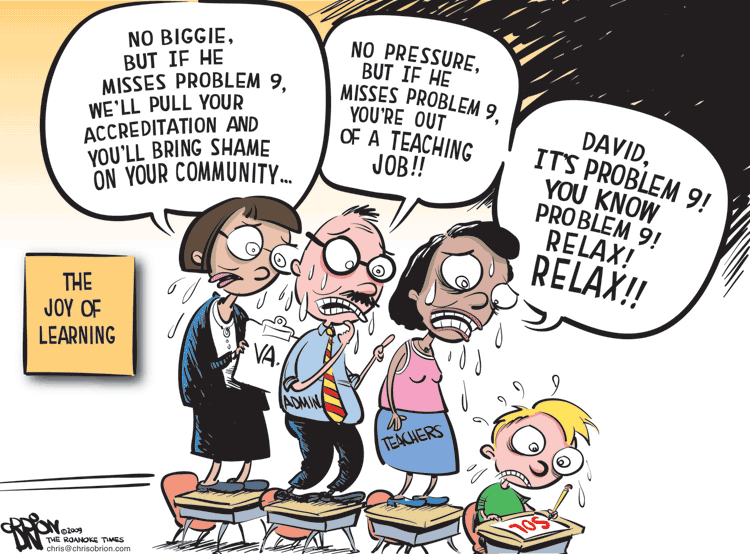
If teachers were to grade their students in an inconsistent, convoluted and subjective manner, they would be run out of the teaching profession.

In their crusade to point fingers and direct blame for the failings of our education system, however, our state's leaders created a similar system for evaluating our teachers.

Florida's policymakers turned a deaf ear to the teachers who tried to point out the inadequacies of the Collaborative Assessment System for Teachers (CAST) when it was being fast tracked through the lawmaking process for the sake of winning a pot of gold from the federal Race to the Top (RTT) grant program.

Nevermind that Florida is the same state that continues to refuse expanding Medicaid on the ground that they do not want abdicate states' rights to empower Washington to impose its will on 50 separate sovereign entities.

The rush to create a data-based evaluation system replaced the thoughtful and reflective process of passing laws with a frenzy to chase after federal funding and with a political power grab that still leaves local school districts dizzy with confusion and disarray.

I was encouraged to read in the Orlando Sentinel a thoughtful column by Beth Kassab that exposes the deficiencies in the CAST system and how it actually hurts the teachers whom we trust to educate our children.

For example, she shares the story of how one Central Florida high school is one of the highest performing schools in the state. This 'A' school enjoys a graduation rate that is the envy of others and yet their learning growth was negative.

"How can this be?" asks Kassab, "How can a school with excellent student performance be populated with clueless teachers?" I know how these same education professionals can improve a school grade and yet be subject to the sanctions and condemnation that are designed to punish more than enlighten.

There are serious inconsistencies in how we rate our schools and our teachers. While FCAT is the instrument for measuring student growth in language arts, mathematics and selected science courses, it was left to the individual school districts to create assessments for the non-FCAT courses. This resulted in a patchwork of 67 school systems with varying benchmarks for student success. The state decided that all courses would have some form of assessment for all non-FCAT courses, but failed to support this mandate with funding. Instead of a reliable system of tracking student progress, we are doomed to compare apples with oranges across county lines.

What is the most absurd aspect of the testing and data driving our perception of public schools is that FCAT scores are often used to tell us what non-FCAT teachers are doing for their students. For example, a guidance counselor or an art teacher can be judged based on schoolwide FCAT numbers. Furthermore, reading scores are being used to indicate the quality of a history teacher's work. The measurements are all over the place and can potentially harm those educators who are indeed trying their best.

Besides the assessment part of teacher evaluations, our leaders presumed that the observation-based section of teacher assessments would be equally objective as the CAST instrument invited administrators to monitor their teachers in the classroom based on one day's worth of sitting in a classroom and using this single class period as the basis for judging a year's worth of teaching.

This, in my opinion, is rife with politics because administrators are given free reign to make up their minds based on an hour's worth of what they see. This simply encourages teachers to design lessons that are geared to impress their superiors and these dog-and-pony shows fail to actually reflect the individual talents for which we have trusted our educators with using in their respective classrooms. Once the observation is complete, the evaluator's word is gospel and all else be damned.

In an age of high stakes testing, this is a most perverse form of high stakes evaluations. Failure to make the grade based on these flawed metrics can ultimately result in teachers' pay being frozen or even in their termination. Yes, the beatings will continue until morale improves.

"We can be an 'A' school and conceivably get that [paycheck] bonus, but if we get three negative scores in a row then the teachers can all be replaced," said one prinicpal in a letter to state lawmakers, according to Kassab's commentary.

Yes, this is a messed up system that is supposed to help our students, but in the meantime is destroying Florida's teaching profession.

For more information about Kassab's commentary, please see this link.

Saturday, March 23, 2013

Thank you, Diane Ravitch!

My friends at the Clay County Education Association informed me this morning that my open letter to Governor Rick Scott was posted on Diane Ravitch's blog.

Dr. Ravitch is a respected and renowned education advocate and I believe that it is an honor to be included in her blog!

An open letter to Governor Scott

Saturday, March 16, 2013

RACE: Are We So Different?


We are different, but only on the surface.

I applaud MOSH for their exhibit that takes an honest and earnest look at the manmade racial categories that overshadow our God-made humanity. It is called "Race: Are We So Different?"

If we are to close our eyes and listen to our brothers and sisters around us, we might have a greater perspective to what they are saying.

Instead, it is impractical to expect us to go about our lives blind to the amount of melanin that defines our individual existence. Reality demands that we see our world in terms of colors and hues that force us to face stereotypes and perceptions each and every day of our lives.

Although I grew up in Orange Park and was sheltered from the crucible of busing and desegregation that defined much of Jacksonville’s local history, I faced the subtleties of race when I attended public schools in Clay County.

As a black student in a majority-white school system, I was fortunate to be staffed into the gifted program. I had the opportunities to take advanced and honors classes that I knew were not enjoyed by my peers of color.

It was a challenge for me to find students or teachers who looked like me. To their credit, Clay County’s public schools were focused on my education regardless of what color my skin happened to be. The fact that I am a productive member of society could be credited to the dedicated men and women who mentored me along my search for knowledge.

This, in my opinion, is the essence of what a color blind society should be. All that I knew was that I had the chance that generations of families risked their lives to attain – a free, quality education for every student. Surely, there were times when I witnessed racism but my youthful optimism permitted me to believe that these incidents were manifestations of the dying gasps of a truly lost cause. This is a mindset that I understand was a luxury that could be afforded to a young suburban upbringing. I am grateful that I did not have to endure the reprisals, recriminations and retaliation that marked the education of many in my generation.

Even when race riots erupted at my high school in the early 1990s, I had the perspective to know that good and bad in our world were not as simplistic as racial lines and stereotypes. This was a defining point for me because I was exposed to the dangers of race matters when they are not addressed in a healthy way.

Today, I am glad to know that our city is taking an honest look into the issue of race to help us come together and learn something new about ourselves and our community.

Perhaps, one day, we will all be able to list ‘human’ when we see ‘race’ on a form or document to complete.

The dream as envisioned by Dr. Martin Luther King, Jr. for a society that sees character over color does not have to be impossible.

See you at MOSH!

Sunday, February 10, 2013

Why I teach and why I fight


I am a teacher because I want your children to succeed.

This is why I maintain a transparent grading process for students and their families to completely understand how I arrived at my grades and how we can work to remedy these grades if indeed we are all trying to make a good faith effort to improve their learning.

I am a teacher because I want your children to make real progress.

This is why I stay up late at night grading papers in my pajamas and this is why I accept late work even if it means that I have to alter my home, family and private life to help your children make the grade. This is why I will often drop everything to even help former students who need letters of recommendation for scholarships, for admission to college and even when they need a job reference.

The politicians and administrators cannot say the same for educators.

This is why I work under a system that uses an evaluation tool that, when it is completed, is written in stone. There is no changing or altering teacher evaluations to include our own efforts to improve ourselves. There is nothing in this instrument that addresses what we do beyond preparing our students for the test that drives everything that we do in the classroom.

The politicians and administrators use the ‘bad’ teachers to justify their witch hunt against all teachers, good and bad. What they do not understand is that the bad teachers may be more effective at coloring between the lines and putting together a show that impresses the right people while the good teachers are forced to spend their own time, treasure and talent on efforts that ultimately get absolutely no recognition.

The politicians and administrators are not interested in teachers who do the right thing.

If they indeed really cared about helping good teachers become better, they would be as swift with the praise as they are with the condemnation. Why is school recognition money distributed at a snail’s pace while the negative news of school grades and teacher growth plans arrives faster than a delivery boy can bring a pizza to my doorstep? I have learned in my professional development classes that it is important for educators to give praise to their students often and efficiently. This is why it makes me and my students happy when we celebrate our successes publicly. I also learned to keep my criticism of student work private as I know that they can do their best when they are not under the pressure of knowing that I will broadcast their failings and challenges. So, why do we treat educators any differently? The main reason why teacher morale is so low in this time of testing and evaluations based on testing is that every day is judgment day for us and the powers that be are much more interested in proving their point that the teaching profession is populated by men and women who rank down there with horse thieves and convicted felons. The system is rigged to punish more than help.

This is why our state legislature and Department of Education are scrambling right now to adjust the teacher evaluation that they created – because there were too many ‘good’ teachers. Surely, there has to be something wrong with this evaluation system, right? There are too many C, D and F school grades and too many teachers who are graded as ‘effective.’ Don’t worry, there will be changes made to make sure that this never happens again. You can take my word for it when I say that next year’s evaluations will present a more ‘realistic’ picture of how awful our teachers ‘really’ are.

The politicians and administrators cannot handle the truth.

This is why we have educators who attempt to present their side of the story and are rebuffed in their efforts. I have a colleague in Florida’s public schools; she sent a portfolio of data and anecdotal evidence of her work to the human resources department of the school system because of the poison pen evaluations that she received from her administrators. They made it a sport to walk into her classroom and degrade her teaching in front of her students.

They took an almost sadistic joy in telling her that, in spite of being a National Board certified, she was not making the grade for her students. They ignored the fact that a former student of hers went on to win the Emmy award for the writing skills that he learned in her classroom. None of what we really do in the classroom matters when politicians and administrators have made up their minds that we need to be taught a lesson. The politicians and administrators do not care what we say or do.

This is why I had a private meeting with some influential people and said that I would be quiet and let the system fix itself. This is why I decided to be polite and back away from being such a loud mouthed activist for a while. What came of this? Some of my fellow union members accused me of selling out because the same shenanigans continued to come from politicians and administrators regardless of what I said or did not say. I learned how to play along and get along and go nothing in return. I extended an olive branch and ended up with a knife in my back.

I will use whatever constructive and legal means that I can to advocate for my profession and for my students. I will use whatever constructive and legal means to exercise my First Amendment rights to challenge the system that attempts to use the tired and trite platitudes that they are putting children first – while insisting that they must put educators and education support professionals last.

This is not a partisan crusade that I am launching today. The late Senator Jim King happened to be a Republican but also happened to be a friend of our state’s public schools. Former governor Charlie Crist was a Republican at the time that he vetoed legislation that I believe was designed to harm our educators. I believe that the leaders in Tallahassee happen to be misguided because of my silence and because of our collective silence. If we do not speak up, they will assume that we approve of everything that they do. There are men and women in our state leadership, beginning with Governor Rick Scott, who are making long overdue overtures to us. They are extending a hand to us that I want to accept in earnest as it takes us all to create a better education system for Floridians that works for all Floridians. That is why I wrote this message, and I approve this message.

Monday, January 21, 2013

One by One, we can help our students and our future


We are the brain trust for improving our public schools for all of our children.

During the years of depression and war, President Franklin Delano Roosevelt assembled some of the greatest minds of his time to coordinate efforts to create a better nation. Today, our elected and appointed leaders have a broad and deep reservoir of ideas and solutions in our community.

Mayor Alvin Brown was right when he said that the key to reducing crime lies in our efforts to transform education to prepare us for the future. Our economy and our quality of life depend on the students of today who will be entering careers and jobs that will form the foundation of our community.

This is why I support the Jacksonville Public Education Fund (JPEF). They are working with the best existing resources in our community to seek consensus for constructive change in how we educate our children. We can either take a greater interest in building strong minds or we can continue to squabble and argue while more of our youngest citizens fall behind.

I know that we can all agree that we can passively lament the crime and poverty that plague Duval County. I, too, have been guilty of turning the channel when the latest tragedy unfolds on the evening news. In our provincialism, we tend to relegate these incidents to the back of our minds as they are supposedly limited to one neighborhood or section of town.

What JPEF accomplishes in their work is to open our eyes to the fact that we can only save a generation by addressing the needs of all of our children, one by one. On a personal level, I took great interest in JPEF as I observed their outreach to all stakeholders in our education system. The school board, educators, education support professionals, parents, students and businesses each have a voice, but we have been weakened by the lack of a unified mission. Through their community meetings, JPEF has succeeded in creating an honest and positive environment for all to be part of the change we sorely need.

I recently ratified the One by One Community Agreement, drafted by a convention of concerned citizens because I endorse their goals, drafted by the grassroots and the foot soldiers in our war against poverty and ignorance. The fact that JPEF actively and openly solicited buy-in from all comers is why I support their consensus-based goals.

Educate the whole child: It is essential that we foster a love for learning in all of our students. The problem with today’s education system is that we have become one dimensional in our zeal to make the basics (e.g. reading, writing and arithmetic) the central theme of educating our students. I believe that we should balance the cognitive and the affective needs of our children in a way that encourages them to appreciate the kind of creativity that fostered a spirit of invention and innovation that led the world in culture, technology and commerce. The whole child requires that we move away from one-size-fits-all learning that neglects the beauty of the world that we want to instill in our students. We also wish not to relegate education to merely bubbling in Scantron sheets and teaching them how to be better test takers.

Great teachers and leaders: The trouble with attracting men and women into the field of education has been that we have been focused on filling vacancies and positions. The gravity of the work that educators do requires a change in our consciousness. More than just mere parts of a large machine, educators are integral parts of an education system that should inspire the best and the brightest citizens to become teachers. Not only is learning a lifelong process, so is teaching. The recruiting of good teachers is only half the battle. It is necessary for us to continually train and develop strong teachers after they are hired. It is also necessary for us to treat these professionals with respect and dignity that we would afford to any other career field.

Policy and political reform: For as long as I remember, politics has been a battlefield that has left many good men and women scarred. The rough and tumble of the political debate has discouraged the very people to whom we should turn for support and solutions. I am grateful that JPEF is encouraging us to take a united front on behalf of our children and to let our elected and appointed leaders know that we will not give up until they listen to our concerns.

Family and caregiver involvement: At a recent town hall meeting with the new superintendent of schools, I heard Dr. Nikolai Vitti talk about the creation of programs to involve families in the education of their children. The bureaucracy and jargon of education speak is enough to scare away the most hardened of administrators and faculty. Imagine how a single parent might feel about having to deal with a labyrinth of paperwork and meetings that confound their attempts to do right by their sons and daughters. We cannot be afraid to adapt our schools and their norms to include more families rather than alienate them.

In closing, I dedicate my heart and my mind to helping to make these priorities a reality. I invite all interested parties to join me in doing so. Thank you, JPEF, for all that you do!

Wednesday, December 26, 2012

Backpage Editorial (FOLIO WEEKLY)

Time to re-evaluate

Teachers are victims of negative typecasting


Folio Weekly, December 25, 2012-January 1, 2013


Every day is judgment day in our public schools. This sounds like hyperbole on my part, but there is a kernel of truth to what I am saying on behalf of educators who are responsible for shaping our future.

At a time when administrators are being trained to nitpick teachers over the most minute of details, such as whether their students are in single-file line, paying perfect attention during lessons or are prepared for class, we overlook the items that fall outside of the rubric with which we judge and ultimately will decide how to pay the troops in the war against ignorance and poverty.

It will never be reflected in the evaluations, observations, or feedback that I receive, but I wish to advocate for one seemingly small experience that I had in the classroom. It has to do with a student who came close to leaving Duval County Public Schools because he feared for his own safety.

Once it came to my attention that this sixth-grade boy was being bullied on a regular basis by a classmate who appeared to be more interested in terrorizing than learning, I worked with administrators and counselors to help this victim overcome the challenge to his own education.

I took the time to listen to the boy's parents as they expressed frustration with what they felt was the glacial pace of a system that had to maintain low disciplinary statistics and pressured its schools into under-reporting incidents for the sake of not losing face in the community. The unintended consequence was an atmosphere where the victims were fleeing for greener pastures such as private schools, charter schools, and homeschooling. The inmates, however, continued to run the asylum. Incidentally, the student who was doing the bullying ended up being arrested for assaulting another schoolmate with a knife later in the year.

Because there was no metric or data to gauge efforts to cooperate with the boy's family and to listen to their concerns, it went overlooked. The state-mandated evaluation system focused more on the superficial aspects of what could be considered "poor" teaching on my part. For example, many teachers get low marks on their evaluations for petty points such as students talking about something other than their work during a lesson. Yes, off-task conversation may reflect negatively on a teacher's ability to keep the focus on the lesson, but we must never lose sight of the fact that there are indeed factors that even the most firm and focused pedagogy cannot deter.

Do not get me wrong here: I did not seek to save a child from chronic bullying and harassment because I wanted to earn a medal or praise for what I was doing. I merely wanted to serve my fellow human being in a way that I would have expected to be helped if I had been a student in the same situation.

On the last day of school before spring break last year, I stayed after work to grade the last of my papers and decided to have a brief meeting with the student's family on my way home from work. Even though I was off the clock, I knew that my vacation could wait until I handled what was a more important matter than packing my suitcases for a week down in Naples with my goddaughter and her family.

I explained to the parent that I was willing to be his child's advocate and that I didn't mind being contacted at any hour, by email or telephone, to remedy their child's situation. After all, he wasn't just a source of funding for our school system; he was a talented young man who had the potential perhaps one day to play major league baseball, report on sports for the media or coach a team when he realized his bright future.

The parents were grateful for the work that our school did on their behalf and they ultimately kept their son enrolled in Duval County Public Schools. They even left a message with my school, thanking us for the work we did for them. Somewhere along the line, the gratitude was ignored and lost in the maelstrom of criticism and stereotyping of rank-and-file teachers as being selfish, lazy bureaucrats who were only in the field of education to collect a paycheck and spend their summers off.

Contrary to popular belief and demonizing, we teachers truly do care. We do what we do because we are giving back to the community that inspired us to answer a higher calling. We have teachers, coaches, administrators and counselors who believed in us and we believe that we can pay it forward.

I should know, because I was a "late talker" in my younger years. My parents feared that I would be mute for the rest of my life. Thanks to speech therapy at W.E. Cherry Elementary School in Orange Park, I learned to become confident in verbally communicating what I had been thinking all along. I learned to express myself thanks to people who didn't give up on me. I, in return, cannot give up on the young people whom I serve every day.

In my own junior high school years, I faced problems that I was able to solve with support from an educational community that helped this introvert learn how to make friends, in spite of losing so many peers to military relocations, and an educational community that helped me to overcome insecurity over my short stature in the shadow of peers who seemed to be growing by leaps and bounds over a child like me who seemed destined never to reach 5 feet tall.

I understand that not all will appreciate with work that we do, because there will always be students who resist our attempts to help them grow academically. But, thanks to remediation, interventions and other methods, we are learning to serve every student who enters our schoolhouse doors.

Bean-counters and micromanagers aside, I continue to soldier on because it is more than a profession for me; it's a moral duty that I must fulfill to justify my continued existence on this earth. It is an obligation that allows us to bear the slings and arrows of "reformers" who wish to visit upon us so-called improvements that are aimed more at punishing us than enriching us. It is something of which we should all be proud, because we keep going in spite of it all.

This is why I continue to do what I do when it's not reflected in the judgment that we receive. The days when I have guest speakers, like the supervisor of elections, the state attorney and members of city council, are days that my former students remember. The times when we have international food days, mock elections and trips to New York are times on which my former students reflect fondly. The memories of students whose funerals I attended, and one where I served as pallbearer, are what I believe to be the true indicators of our dedication.

Perhaps our friends in Tallahassee will never recognize our true value in our work, but I continue to teach not for them, but for the future.

Meeks has been teaching social studies in Duval County since 2002. He is a 1998 graduate of the University of North Florida.

Monday, November 12, 2012

A post-partisan Florida


The political system in Florida is bland and in need of some flavor that truly speaks to the voices of all Floridians. Ever since the Sunshine State flipped in favor of the current ruling majority, we have been missing the kind of red pepper that would bring the spice of variety to our public discussion and would create a system that truly works for all.

I lack any basic cooking skills, so I am not necessarily referring to a potluck that would throw someone of their bland diet. I speak metaphorically of the squashing of liberal and progressive voices at the hand of those who are more interested in perpetuating their own political power for their own means than on actually uniting a state that consists of more than just the yes men and women who cater to the needs of the ruling establishment.

Based on the gerrymandering of legislative districts and the wholesale auctioning of our agenda to the moneyed interests, one would not know that registered Democrats actually outnumber Republicans by nearly 400,000. Instead, we are subjected to an overconfident and cocky clique of politicians and lobbyists who wield their power like a club over their foes.

I remember that, in 2000, a mere 537 votes meant the difference between a Bush and a Gore administration for the nation, but the majority party chose to rule by fiat and mandate. They chose to eschew consensus for their ability to bully the powerless and exact revenge on those who disagree with them.

Our state's misplaced priorities were made manifest when they made the private issue of a brain-dead woman their priority while they attempted to write death warrants on public workers, labor unions, trial attorneys, environmental activists and those who stood in the way of their political dominance.

Our leaders did not become drunk with power on their own. The collective silence of the minority gave the false impression that Florida was willing to be led down the primrose path to fulfilling every whim designed by former governor Jeb Bush and the special interests who continued to ignore those who did not have the same access to the powers that be in Tallahassee.

In what may be an outlier of future election cycles, even the young Cubans of South Florida turned 'blue' as they have no concrete memory of the Cold War grudges that inspired a voting bloc to be firmly in the pocket of our state leadership. No longer can they be taken for granted and neither can the moderates and independents who live along Interstate 4. Hillsborough County ultimately held the keys to the White House for our 29 electoral votes and it will surely be pivotal to winning the governor's mansion.

For whatever criticism and abuse that was heaped upon former governor Charlie Crist, he should be lauded for his willingness to understand that leading means more than just pandering to the base of a party that turns a deaf ear to Floridians who are in dire need of representation and are desperate for more unity and less demonizing. The latest attempt by the state legislature to rig the rules of the game in their favor seemed to be a done deal because they had the super majority in the capitol, a lock on the state cabinet and buckets of money being tossed their way. What they did not count on was an equally powerful voice of people who rallied to finally say that they had enough with overreach and abuse from on high.

I am sure that we all assumed that Governor Rick Scott would have understood this when he defeated a Tallahassee insider to win his primary election for governor. We all assumed that an outsider would truly change the system for the better because he successfully made the case that he would do a much better job than the Democratic candidate whom he tagged as part of the dysfunctional system. He won by a slim margin because he showed promise. The promise of serving all Floridians, however, was bogged down by his reaching out to the same insiders whom he opposed when he originally decided to run for office.

While it is a smart choice to be fiscally responsible, the governor swapped his scalpel for a chainsaw with which he made devastating cuts to the educational system he promised to change. He opted to turn a deaf ear to the parents, teachers, school boards and superintendents who warned him that he and his administration were going too far. It did not really matter to our state's leadership because they had a firm grip on the levers of power and they would do anything in their power to stay on top.

I should know the impact of this draconian system of governance because I, along with many public workers, was forced to take a pay cut in order to balance our state's budget. I am confident that our state's Supreme Court will rule that this betrayal of our pension system dating back to the 1970s was indeed an abuse of our state's constitution.

The absolute power that resides in our state government, however, could not abide the rule of law. Our legislators, in their infinite wisdom, decided that it was time to mount a full-on attack on the sectors of government that would not tow the line. The laundry list of constitutional amendments and the assault on our judiciary branch failed because Floridians realized that the foundations of our state's political system were in danger.

What disappointed me most was the efforts of our state to shrink the window for early voting because they were dissatisfied with the results of previous elections. I know of no other time in our history that limiting voting resulted in a positive result for our citizens. I am proud that Floridians saw through this ploy and waited hours in line to show that they will not be scared or intimidated.

The arrogance of the likes of State Senator John Thrasher are even more pronounced as they claim to be victims of a powerful federal government that forces the states to relinquish their powers. The balance of power, however, has been ruined over the past generation as Tallahassee chose to usurp home rule in our 67 counties and our countless municipalities in the form of revenue policy that shifts the burden to local government, forces unfunded mandates onto our local governments and claims to be the advocates of less government.

The tide is turning in favor of more level-headed political discourse and I look forward to this trend continuing in 2014 as our state has a real debate on ideas and vision as opposed to wheelbarrows of cash pouring into the same hands that drove us into the mess that we are in today.

The red pepper? Former senator and congressman Claude Pepper is the kind of politician who we need to bring back balance to a truly purple state in a time when our leaders are less interested in leading than in dictating.

"If more politicians in this country were thinking about the next generation instead of the next election, it might be better for the United States and the world." - Claude Pepper

Tuesday, October 16, 2012

Learning knows no color - my Times-Union commentary


Four decades after strife and struggle marked race relations in our nation, Florida appears to be taking a step backwards in our work with minority children in the classroom.

In 1965, President Lyndon Baines Johnson addressed Howard University on this very issue, telling Howard University of the perils of freedom when Americans have been playing a catch up game with regard to all Americans having a fair chance to succeed.

You do not take a person who, for years, has been hobbled by chains and liberate him, bring him up to the starting line of a race and then say, "you are free to compete with all the others," and still justly believe that you have been completely fair.

While I understand the reasons behind the state Board of Education’s directive to set student progress goals by race, I respectfully disagree on the grounds that this new policy directly contradicts the goals that we have planned for real accountability in schools.

All along, teacher and parent organizations chafed at the punitive approach that our state’s leaders have taken with what was supposed to be standardized testing to diagnose the ills that are harming our students. All along, teacher and parent organizations pleaded with the state to take into account the factors that negatively affect our public schools.

Our problem is not racial, our problem is poverty. We miss the point when we believe that an African-American student in a relatively prosperous ZIP code needs to be given a pass in meeting the standards. I would point out that students, regardless of race or ethnic group are struggling because they happen to come from disadvantaged backgrounds.

Look at the neighborhood schools with high percentages of students who are on free and reduced lunches. The data will point out that failure knows no color. Socioeconomic status is what really dictates how students will perform on standardized tests.

While it is easy for us to change the rubric for student success to yield better numbers, the real work at hand is for us to change the circumstances that hobble our young people.

Regardless of our ideology, we all continue to fight a losing war on poverty that can only be addressed in ensuring that all citizens prosper with better jobs, better wages and better quality of life.

This, of course, is not going to be easy because we have been fighting a recession that seems to be as endless as the number of students who are dropping out of school and being lost to the criminal justice system or the welfare state.

The beginning of the real solutions is for our state’s leadership to finally listen to the people and to finally set aside petty partisan grievances and games to afford all Floridians a chance to work together for better schools that work for all.

The obvious answer, say many, it to divert more public funds to charter, private and parochial schools. This neglects the fact that we still have to operate public schools as our state constitution mandates in accordance with a paramount duty to do right by our students.

We are right to decry efforts to water down standards for minorities for the sake of moving children of color along. We are right to question Affirmative Action programs that ask more from white and Asian children simply because of the color of their skin.

What frustrates me about this issue is that this is a bed that we have made and now we are being forced to sleep in. What frustrates me is that we are tacking the same problems that we were warned about when FCAT turned from a helpful tool to a cudgel with which to assault educators who toil daily to meet the needs of all children.

The right thing for us to do now is to stop and repair this dysfunctional system that begins not in the classroom but in the pocketbooks that deprive many of our young people of an equal chance to succeed and in the economic policy that can put more people to work.

John Louis Meeks, Jr. currently resides in Jacksonville, Florida where he teaches social studies at Mayport Middle School. He is a 1998 graduate of the University of North Florida and a veteran of the United States Air Force.

Source: http://jacksonville.com/news/florida/2012-10-14/story/florida-taking-step-backward-setting-standards-based-race

Saturday, September 29, 2012

Starving for knowledge


I cannot teach on an empty stomach. I already know the consequences of allowing low blood sugar to dictate how the rest of my day is going to go because I have often sacrificed breakfast in the triage of having a quick morning routine. We know of that devil's bargain that we make when we wake up after the snooze was activated for the ninth time - I will jump in the shower, shave my stubble and get dressed on the way to the car (not literally!). Breakfast is the first of the things that I chose to omit because a smelly teacher was ostensibly much more noticeable than a hungry teacher. Well, thanks to decreased functioning and a crankier outlook on the day, I realize that breakfast can have as much an impact on my work as five o'clock shadow. Both problems make me appear run down even before the clock strikes twelve. Conversely, we are very aware when we notice that a student has skipped showers. The smell can especially pungent in a middle or high school setting. All of the Axe deodorant in the free world cannot mask a deficiency in bathing. When students arrive in the classroom after missing breakfast, however, the results are a lot more subtle. Stomachs may not growl and teachers may not know the warning signs of a student who has a challenge with nutrition at home. I was made aware of this, as I posted on my school blog, when a student came to class with what seemed to be a giant monkey on her back. She could not focus on her work and I was worried about what was troubling her. She forthrightly told me that she did not have anything to eat that morning as her cupboard was bare. I made a deal with her that I would bring breakfast foods so she could ask for help when she needed it. Upon further research (http://www.dailyfinance.com/2011/08/25/where-americas-children-are-going-hungry/), I discovered that over a quarter of Florida's students live with 'Childhood Food Security' and one out of ten Floridians experienced the same issue of having little to nothing to sustain them. If we truly believe in education reform, we must reform the way our children are fed. Private partnerships are necessary to help all public school students to not just feed their minds, but their bodies.

Friday, August 31, 2012

Eternal Flame


The New Frontier lives through us today. Ever since 1961, when President John F. Kennedy urged a new generation of Americans to carry the torch and answer the clarion call to action, Americans have been inspired to serve their fellow man. Next year will mark the 50th anniversary of the violent and untimely end to Camelot and I am working on a book that compiles Floridians' memories of President Kennedy and his dream of a better world that works for all. I am sending a call to you who were alive during this dynamic period of our nation's history to share with me your reflections on the thousand days that marked a transformative time for Americans and citizens of the world. If you would like to submit your thoughts to be included in my book, please send me a 500 word essay that explains what President Kennedy meant to you. Please include memories or recollections of the Kennedy years. Please send me your essay by emailing me at johnmeeks@bellsouth.net. I will review all submissions and will work very hard to ensure that all submissions are published. In these times when politics can be a dirty game and a devil's bargain, I want us to look back to a time when anything was possible for our world and I want to remind us that we can return to believing in ourselves again. I hope to have this book published by the summer of 2013. Time is of the essence as time marches on and I want to preserve your thoughts while we are still here to share our memories. Please email me if you have any questions!